PR Pitching Mistakes to Avoid (and How to Fix Them)
When people talk about pitching mistakes, they usually talk about writing: a vague subject line, a pitch that runs too long, a typo in the journalist's name.
They do matter.
But in the AI era, writing is the easy part. Any AI tool can give you a clean, well-structured pitch in seconds.
As Head of Product at Propel, I spend my days looking at how PR teams actually pitch. From where I sit, the mistakes that cost coverage rarely happen in the pitch itself. They happen around it: who gets the email, how it's sent, when it lands, what happens after, and what you didn't know before you hit send.
These are workflow mistakes.
And they happen to good PR people, because a single pitch now moves through a media list, a spreadsheet, an inbox and a tracker, usually under deadline.
In this article, I'll walk you through the five pitching mistakes I see most, the habit that prevents each one, and how we built the Propel plugin for Gmail and Outlook to make that habit the default.
Mistake 1: Opening with a generic message
"Hope you're well. I wanted to share…" A generic opener can work when you're writing to a few journalists you already know. On a large list, it doesn't work.
Journalists spot a mass pitch in the first line. The bigger the list, the more each message needs to feel written for one person.
The habit: Before you pitch, find one recent article and mention it in your first sentence. As simple as it sounds, this is relatable and a bit more personalized.
Use the Propel plugin to fix this: AI Intro writes a personal opening for each journalist, based on what they've recently written. Every intro lands as a draft, so you review it before it's sent. If a journalist has no recent articles in our database, no intro is created. We'd rather leave it blank than guess.
Mistake 2: Sending one email to everyone
One email to 40 journalists in BCC saves an hour. But this is not the right way. It reads like a newsletter - and you can't tell who opened it.
The habit: Send one pitch to one journalist from your email address.
Use the Propel plugin to fix this: Mail Merge sends one pitch to your whole list as individual emails from your own inbox. Every email is tracked separately, and recipients never see each other.
Mistake 3: Pitching on your schedule - not theirs
A strong pitch that lands late at night, their time, is buried by morning.
The habit: Send when they're reading - not when you finish writing.
Use the Propel plugin to fix this: PitchBooster sends each pitch when that journalist is most likely to engage, based on their engagement patterns, and it goes out on time even when you're offline.
Mistake 4: Following up after they've already replied
Nothing says "automated" like a follow-up that lands an hour after the journalist said yes.
The habit: follow up once, in the same thread, only with people who haven't answered.
Use the Propel plugin to fix this: Follow-ups go in the original thread, only to journalists who haven't replied. If a journalist replies first, the scheduled follow-up is cancelled automatically.
Mistake 5: Pitching without knowing the history
Your colleague pitched this reporter last month. You didn't know. The reporter did.
The habit: Check the history before you write.
Use the Propel plugin to fix this: The Propel sidebar shows your team's notes on a journalist while you write to them and whether they opened your last pitch, and it lets you update the pitch status without leaving your inbox.
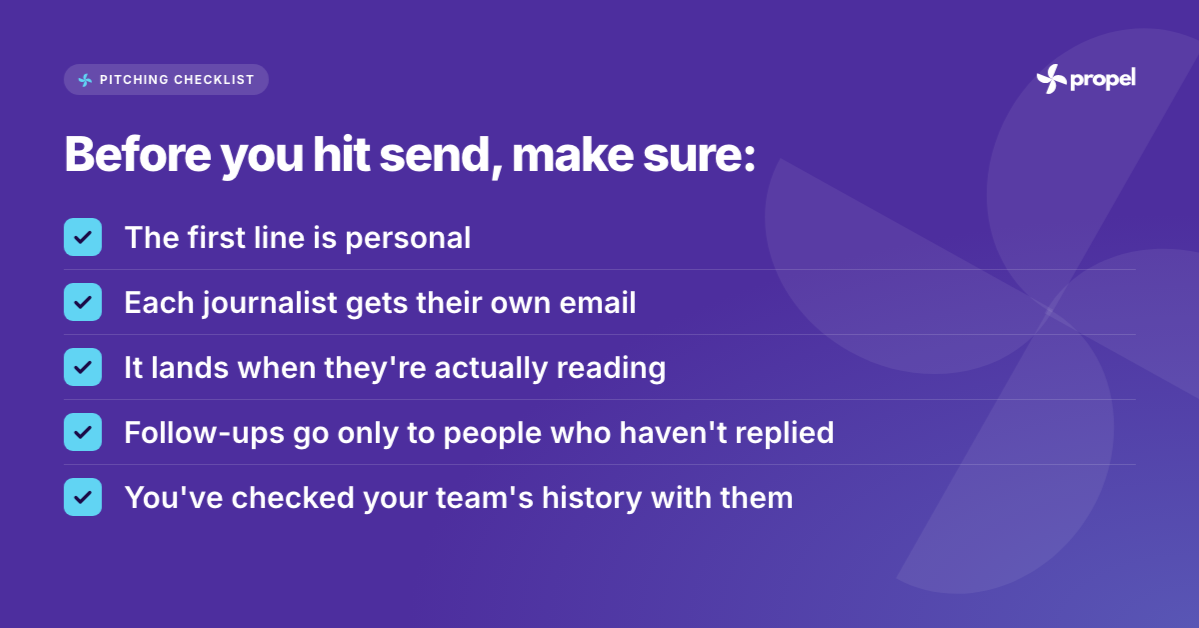
These are the mistakes I see most often, and none of them is hard to fix once it becomes a habit. I'd highly recommend every PR team to avoid them, whether you're pitching a handful of journalists or a few hundred. To make it easy, here's a simple checklist you can use before every pitch:
Why This Matters More in the AI Era
AI made it much easier to write and send more pitches. It also made it easier to repeat a mistake at scale. A bad habit used to cost you one pitch. Now it can cost you a whole media list in one afternoon.
That's how we think about building Propel. When we see the same mistake again and again, our job is to make it hard to make. The story, the angle and the relationship stay with you. And our plugin takes care of the rest.